

If you’re an early or mid-career professional in Nigeria or Ghana dreaming of a world-class postgraduate education abroad, your opportunity to apply for the Ireland Fellows Programme just opened.
The Government of Ireland, through the Ireland Fellows Programme, has launched applications for its 2027/28 fully funded Masters scholarship, giving qualified candidates the rare opportunity to study at a leading Irish university with every major expense covered. Here’s everything you need to know.
What Is the Ireland Fellows Programme?
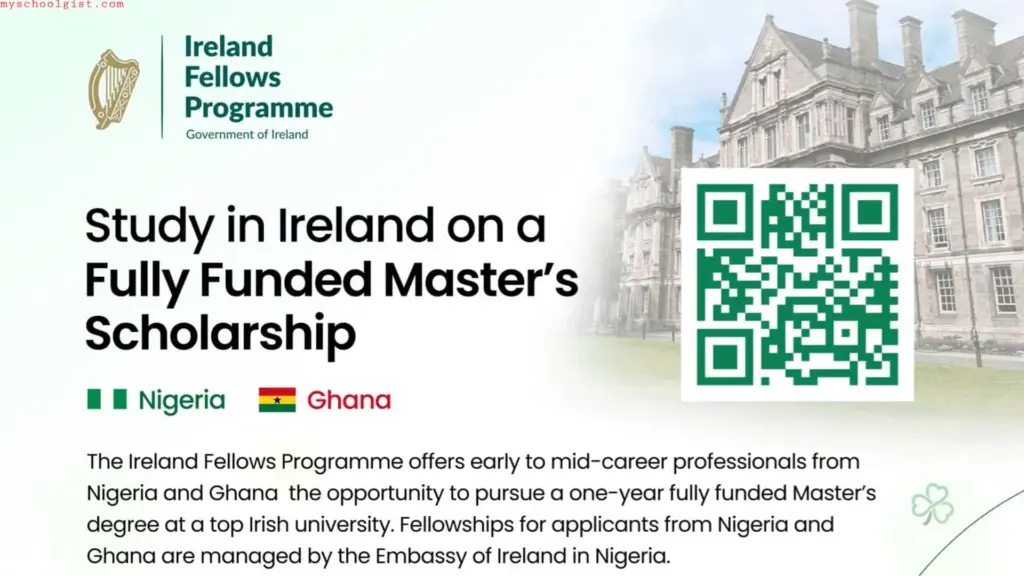
The Ireland Fellows Programme is a prestigious scholarship initiative funded by the Government of Ireland and administered by the Embassy of Ireland in Nigeria. It is designed to support early to mid-career professionals from select African countries, who want to pursue a one-year Master’s degree at a top Irish university.
The programme’s core goal is to equip talented professionals with advanced skills and knowledge that they can bring back and apply in their home countries, contributing to national development. It is more than just a scholarship, it’s a fellowship that builds a lasting connection between Ireland and Africa’s next generation of leaders.

Quick Summary of Scholarship Details
| Detail | Information |
| Programme | Ireland Fellows Programme 2026 |
| Funder | Ireland 🇮🇪 Government |
| Eligible Countries | 24 African countries, including Nigeria and Ghana |
| Degree | One Year Masters (Fully Funded) |
| Application Opens | June 29, 2026 |
| Application Closes | July 26, 2026 |
| Official Portal | https://irelandfellows.africa |
What Does the Scholarship Cover?
This is a fully funded scholarship in the truest sense. Successful candidates will receive a comprehensive package that includes:
- Full tuition fees for the one-year Master’s programme.
- Return flight tickets (airfare to and from Ireland)
- Visa costs fully covered.
- Monthly living allowance for day-to-day expenses
- Accommodation stipend throughout the duration of the programme
- Health insurance for the entire study period
In short, if you are selected, you will not need to pay a single kobo or cedi out of your pocket to complete your Master’s degree in Ireland.
Special Fellowship for Nigerian Applicants: The Roger Casement Fellowship
For Nigerian candidates specifically, the Ireland Fellows Programme includes a dedicated track called the Roger Casement Fellowship in Human Rights. This fellowship is tailored for professionals seeking postgraduate study in fields such as:
- Law
- Human Rights
- Governance
This reflects Ireland’s longstanding commitment to human rights advocacy and its desire to support professionals working in justice, policy, and governance across Africa.
Available Fields of Study
While Nigerian applicants are currently directed primarily toward the Roger Casement Fellowship (Law, Human Rights, Governance), Ghanaian applicants have access to a broader range of eligible disciplines, which include: Agriculture, Health, Education, Human Rights, Engineering, Business, and other approved fields.
Who Can Apply for Ireland Fellows Programme 2027/28 (Eligibility Requirements)
The Ireland Fellows Programme is open to professionals across 24 eligible African countries, not just Nigeria and Ghana. The full list includes: Angola, Burundi, Democratic Republic of Congo, Djibouti, Eritrea, Eswatini, Ethiopia, Ghana, Kenya, Lesotho, Liberia, Malawi, Mozambique, Nigeria, Rwanda, Senegal, Sierra Leone, Somalia, South Sudan, Sudan, Tanzania, Uganda, Zambia, and Zimbabwe.
Note: The portal irelandfellows.africa is specifically coordinated for Nigeria and Ghana applicants by the Embassy of Ireland in Nigeria. Applicants from other eligible countries should contact their respective Embassy of Ireland for country-specific guidance and application forms.
To qualify, all applicants must meet the following core criteria:
- Nationality & Residency: You must be a citizen and current resident of an eligible country. Dual nationals residing abroad are not eligible.
- Academic Qualification: You must hold a Bachelor’s degree with a minimum of Second Class Lower (2:2) or a GPA of 3.0 on a 4.0 scale, from an accredited institution. The degree must have been awarded in 2013 or later (within the last 12 years).
- Work Experience: You must have a minimum of 2 to 3 years of relevant professional experience directly related to your proposed programme (the exact requirement varies by country; Nigeria requires 3 years).
- You must not already hold a Master’s degree or higher, nor be currently enrolled in any postgraduate programme.
- You must be applying to commence a brand new course starting no earlier than August 2026. Funding is not available for programmes already started.
- Programme Selection: You must select three relevant programmes from the official Ireland Fellows Programme Directory of Eligible Postgraduate Courses. Choose carefully — the order you list them matters, as priority is given to your highest-ranked choices.
- You must not have applied to the Ireland Fellows Programme on more than one previous occasion.
- You must demonstrate English proficiency. An IELTS score of at least 6.5 (with no component below 5.5) is required. If you don’t yet have an IELTS certificate, you can still apply at Stage 1, but you’ll need it at later stages.
- You must provide a letter of reference from your employer along with a completed Employer Endorsement Form.
- Return Commitment: Fellows are expected to return to their home country after completing the programme. The fellowship does not cover spouses or dependants.
Application Dates
The application window is very short:
Opening Date: Monday, June 29, 2026.
Closing Date: Sunday, July 26, 2026
You have less than four weeks to prepare and submit your application. Do not wait until the last minute, gather your documents, check eligibility, and apply as early as possible.
How to Apply for Ireland Fellows Programme 2026
The Ireland Fellows Programme uses a three-stage application process. Here’s how it works:
Stage 1: Preliminary Application (Opens June 29th, 2026)
This is the initial eligibility and screening stage. Complete the Stage 1 application form with your personal details, academic background, work experience, programme choices, and a personal statement. Your statement is critical as the selection panel scores it heavily. You’ll need to address three key areas (max 150 words each):
- Why you want to pursue this Master’s and how it relates to your work
- How the fellowship will contribute to development in your home country
- How you would propose to develop links between your country and Ireland
Submit your Stage 1 application via irelandfellows.africa (for Nigeria/Ghana applicants) or to your country’s Embassy of Ireland by email for all other eligible countries.
Stage 1 Deadline: July 26, 2026
Stage 2: Full Application + English Language Test
If shortlisted after Stage 1, you will be invited to submit a full application with supporting documents, including:
- Certified copy of your degree certificate and academic transcripts
- Two letters of recommendation
- Completed Employer Endorsement Form
- Copy of your passport (identity page)
- Your current CVIELTS score report (if available)
All shortlisted Stage 1 applicants will also be required to sit an online Duolingo English Test at this stage. Do NOT apply directly to Irish universities at this point. You will be formally invited to do so only if you progress further.
Stage 3: Interview + IELTS
Final-stage candidates will be invited to an interview conducted by the selection panel. At this stage, a valid IELTS certificate (dated 2024 or later) with a minimum overall score of 6.5 is mandatory. Candidates without a valid certificate will be required to sit the IELTS exam. Only after clearing this stage will successful candidates be formally offered a fellowship and invited to apply to Irish universities.
Arrivals in Ireland are expected in August–September 2026, with the academic year running through to June–September 2027.
For Nigeria & Ghana applicants:
For all other eligible countries: Contact your local Embassy of Ireland
Tips Before You Apply for the Ireland Fellows Programme
Start early. With a one-month window, don’t delay gathering transcripts, references, and personal statements.
Review eligible programmes on the portal before applying, and ensure your chosen Master’s degree is listed as an approved programme.
Tailor your statement of purpose to demonstrate how the fellowship aligns with your professional goals and how you plan to apply your learning back home.
HND holders should carefully check eligibility criteria on the official portal, as some concerns have been raised about HND qualifications. The portal will carry the most authoritative guidance.
This is a rare, fully funded opportunity from a credible government-backed programme. If you meet the requirements, there is no reason not to apply. Share this with a colleague, friend, or family member who could benefit.
Read also: NNPC-Renaissance JV Scholarship 2026: Eligibility, Documents, and How to Apply


Pingback: Meet Nigeria's Youngest Chartered Accountant, 16-Year-Old Osasere Okundaye | Exam Scholars- JAMB Exam
Pingback: WHO Internship Programme 2026 Open: Fully Funded Public Health Internship | Exam Scholars- JAMB Exam