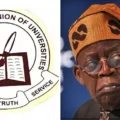

FG’s Neglect Fueling Education Crisis — ASUU
The President of the Academic Staff Union of Universities (ASUU), Prof. Chris Piwuna, said that the Federal Government does not prioritise education because its officials do not view the sector’s problems as national issues that require shared responsibility.
During The Toyin Falola Interviews on Sunday, in a virtual talk called “A Conversation with the ASUU President”, Piwuna noted that the indifference of key government officials toward education has made it hard to implement lasting changes.
He pointed out that members of the Federal Executive Council often see educational issues as only the responsibility of the Minister of Education.
ASUU has historically relied on strikes to push for its demands.
Recently, the union has defended its strikes as a reaction to government proposals it considers a “total departure” from the terms of the 2009 FGN-ASUU Agreement. They also address ongoing issues like unpaid promotion arrears, withheld deductions, and inadequate funding and renovation of public universities.
“When ASUU goes on strike, the Minister of Finance looks at it as an issue only for the Minister of Education. The Minister of Science and Technology feels the same way.
“However, if the Minister of Finance understood that the country’s economic progress depends on a skilled workforce, he would see the Minister of Education’s challenges as his own concern. The same goes for other ministries,” Piwuna emphasised.
He mentioned that ideological conflicts and corruption have also hindered the federal government’s response to educational issues.
“We in ASUU believe that education is a public good, but those in power treat it like a business, something relevant only if it makes money.
“Many of them now suggest that TETFund should start funding private universities. Even the former Chief of Staff to the President, who didn’t support that while in office, is now a pro-chancellor advocating for it. Personal interests and inflated contracts have replaced public service. That’s why TETFund has become a marketplace,” he explained.
The host, a historian and scholar, Prof. Toyin Falola, provided a historical background on ASUU’s ongoing struggles with the Federal Government and the repeated strikes that have disrupted academic schedules for years.
Other participants included Prof. Francis Egbokhare from the University of Ibadan, economist Prof. Sherrifdeen Tella, Nigeria Labour Congress President Joe Ajaero, and journalist Grace Oedema from The PUNCH.
Prof. Egbokhare stated that Nigeria’s university system suffers from poor leadership, decaying infrastructure, and weak accountability.
“What we are seeing is a failure of leadership, especially among governing councils,” he said.
“When you look at our universities, you see poorly built facilities at a time when sustainable design should be standard. We need to fix issues of leadership selection and integrity in our universities. We cannot complain about the system and continue to be part of its problems.”
He also suggested that funding should not be the only focus, pointing out that universities could boost their income if government ministries worked with them for consulting, research, and training services.
“It’s not just about financial resources; it’s also about funding methods. If government agencies collaborated with universities for research and consulting, more resources would flow within the system,” he remarked.
NLC President Joe Ajaero called on both the government and ASUU to take a holistic approach to solve the educational crisis.
“It has been tough for ASUU leaders. However, beyond autonomy, we also need to address the state of primary and secondary education,” Ajaero said.
Economist Prof. Sherrifdeen Tella stated that the lack of focus on research in Nigeria has slowed the country’s development.
“When farmers use high-quality seeds that lead to better harvests, it comes from research done by scholars. Unfortunately, the research sector has been neglected for too long,” he said.
While addressing the ongoing ASUU National Executive Council meeting in Taraba State, Piwuna said that discussions about the union’s negotiations with the Federal Government are nearing completion.
“The terms of the agreement are coming together, and we expect to announce a conclusion within the next week or two.
“However, the salary offer we got from the government is unacceptable, and we are ready to take serious steps to contest it. Our salaries are far from satisfactory.
“All the wealthy individuals have set up private universities; none contribute to public universities. We tried to engage with them—even during the last administration—but it led to nothing,” he stated.
Piwuna also remarked that the current condition of academia in Nigeria is forcing lecturers into survival mode, leaving little room for creativity or funding opportunities.
“Some of our colleagues have to sleep in their offices with their families due to poor living conditions.”
“How can people in this situation be expected to secure funding or lead high-level research? We are still struggling to move beyond the 17th century, let alone reach the 18th,” he said.

DOWNLOAD EXAM SCHOLARS 2025 CBT APP ON THE PLAY STORE
DOWNLOAD EXAM SCHOLARS 2025 CBT APP ON THE APP STORE
DOWNLOAD EXAM SCHOLARS 2025 CBT APP ON WINDOWS
Visit EXAMSCHOLARS.COM for more info