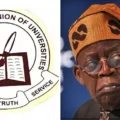

FG Neglect Causing Education Crisis — ASUU
The education crisis continues because the Federal Government ignores the sector, according to ASUU.
Recently, the union has often justified strikes by claiming that government proposals greatly differ from the previously accepted terms of the 2009 FGN-ASUU Agreement. Unresolved issues like unpaid promotion arrears, unprocessed deductions, and inadequate funding and maintenance of public universities also contribute to this situation.
“Government officials, including ministers and chief executives, do not see the education crisis as a concern for them.”
“When ASUU starts a strike, the Finance Minister sees it as the Education Minister’s problem; similarly, the Minister of Science and Technology shares this perspective.”
“If the Finance Minister recognised that the nation’s economic growth depends on a skilled workforce, he would view the Education Minister’s challenges as his own. The same goes for other ministries,” Piwuna said.
He added that the Federal Government’s handling of educational issues is complicated by ideological differences and corruption.
“We in ASUU consider education a public asset, while those in power treat it as a business, only relevant when it generates profit.”
“Many are now suggesting that TETFund should start funding private universities. Even the former Chief of Staff to the President, who previously opposed such ideas, is now a Pro-Chancellor supporting this notion. Self-interest and inflated contracts have overtaken public service. This is why TETFund has turned into a marketplace,” he commented.
The host, historian and scholar Prof. Toyin Falola, provided a historical overview of ASUU’s ongoing conflicts with the Federal Government and the repeated strikes that have disrupted academic schedules for many years.
Additional contributors included Prof. Francis Egbokhare from the University of Ibadan; economist Prof. Sherrifdeen Tella; Nigeria Labour Congress President Joe Ajaero; and journalist Grace Oedema from The PUNCH.
Prof. Egbokhare pointed out that Nigeria’s higher education system suffers from poor leadership, decaying infrastructure, and a lack of accountability.
“What we are experiencing is a failure of leadership, especially within governing councils,” he said.
“When you look at our universities, you see poorly constructed buildings at a time when sustainable design should be the norm. We need to address problems with leadership selection and integrity within our universities. We cannot criticise the system while still contributing to its issues.”
He also argued that funding should not be the only focus. He emphasised that universities could increase their income if government ministries sought their help for consultancy, research, and training services.
“It’s not just about funding but also about different funding methods. If government bodies worked with universities for research and consultancy, it would lead to more resources flowing within the system,” he noted.
In his remarks, NLC President Joe Ajaero urged both the government and ASUU to take a broad approach to solve the educational crisis.
“It has been a tough time for ASUU leaders. However, along with autonomy, we must also address the state of primary and secondary education,” Ajaero said.
Economist Prof. Sherrifdeen Tella highlighted that neglecting research in Nigeria has contributed to the country’s underdevelopment.
“When farmers choose quality seeds that lead to better yields, it comes from academic research. Unfortunately, the system has ignored research for a long time,” he stated.
During the ongoing ASUU National Executive Council meeting in Taraba State, Piwuna mentioned that discussions about the union’s negotiations with the Federal Government are nearing completion.
“The details of the agreement are forming, and in the next week or two, we will provide a clear statement.
“However, the salary proposals from the government are unacceptable, and we are ready to take all necessary steps to challenge them. Our salaries are far from adequate.
“All the wealthy individuals have set up private universities; none of them contribute to public universities. We have approached them—even during the previous administration—but there has been no positive response,” he said.
Piwuna further explained that the current educational situation in Nigeria is forcing lecturers into survival mode, leaving little chance for creativity or contributions.
“Some of our colleagues spend the night in their offices with their families because of poor living conditions.”

DOWNLOAD EXAM SCHOLARS 2025 CBT APP ON THE PLAY STORE
DOWNLOAD EXAM SCHOLARS 2025 CBT APP ON THE APP STORE
DOWNLOAD EXAM SCHOLARS 2025 CBT APP ON WINDOWS
Visit EXAMSCHOLARS.COM for more info